.webp)


The incidence of melanocytic and non-melanocytic skin cancers continues to rise steadily, and they are currently among the most common tumor entities in the Caucasian population. Melanoma is responsible for 90% of all skin cancer deaths. With timely diagnosis, all forms of skin cancer can generally be treated with a high chance of cure, which makes early detection particularly important. In addition to the “classic” methods for (early) detection of skin cancer, such as dermatoscopy, neural networks based on artificial intelligence (AI) have increasingly established themselves in recent years.¹–¹²
The number of reports on potential applications of AI for classifying various benign and malignant skin lesions has been steadily increasing in recent years.²–¹² Several large international studies³–⁶,¹² have shown that AI can outperform experienced dermatologists in correctly identifying different types of skin cancer (both melanocytic and non-melanocytic) in experimental settings. Other studies⁵ also emphasize that the diagnostic accuracy of dermatologists is higher when supported by AI than without it. The greatest benefit was observed particularly among clinicians with less experience in dermatoscopy.
In clinical practice and in prospective studies²,⁷,⁸, total body photography (TBP) has proven to be a relevant factor in early melanoma detection, alongside sequential video dermatoscopy. Modern TBP systems, supported by both hardware and software, now also use AI to automatically identify new or changed lesions in follow-up images. Studies have shown that the diagnostic accuracy of dermatologists in classifying benign and malignant skin lesions could be improved with this application and subsequent AI systems for analyzing dermatoscopic images.
Recent advancements in TBP now make it possible to create 3D avatars of patients from multiple individual images, covering over 95% of a patient’s body surface.⁹
In recent years, AI in medicine has been used not only in clinical settings but increasingly in applications for laypeople. So-called “consumer apps” for smartphones are becoming more and more popular, largely due to their ease of use and the ubiquitous availability of smartphones. These apps are most widespread when it comes to image interpretation — for example, in dermatology for skin cancer detection. Behind these algorithm-based applications are trained neural networks based on artificial intelligence.
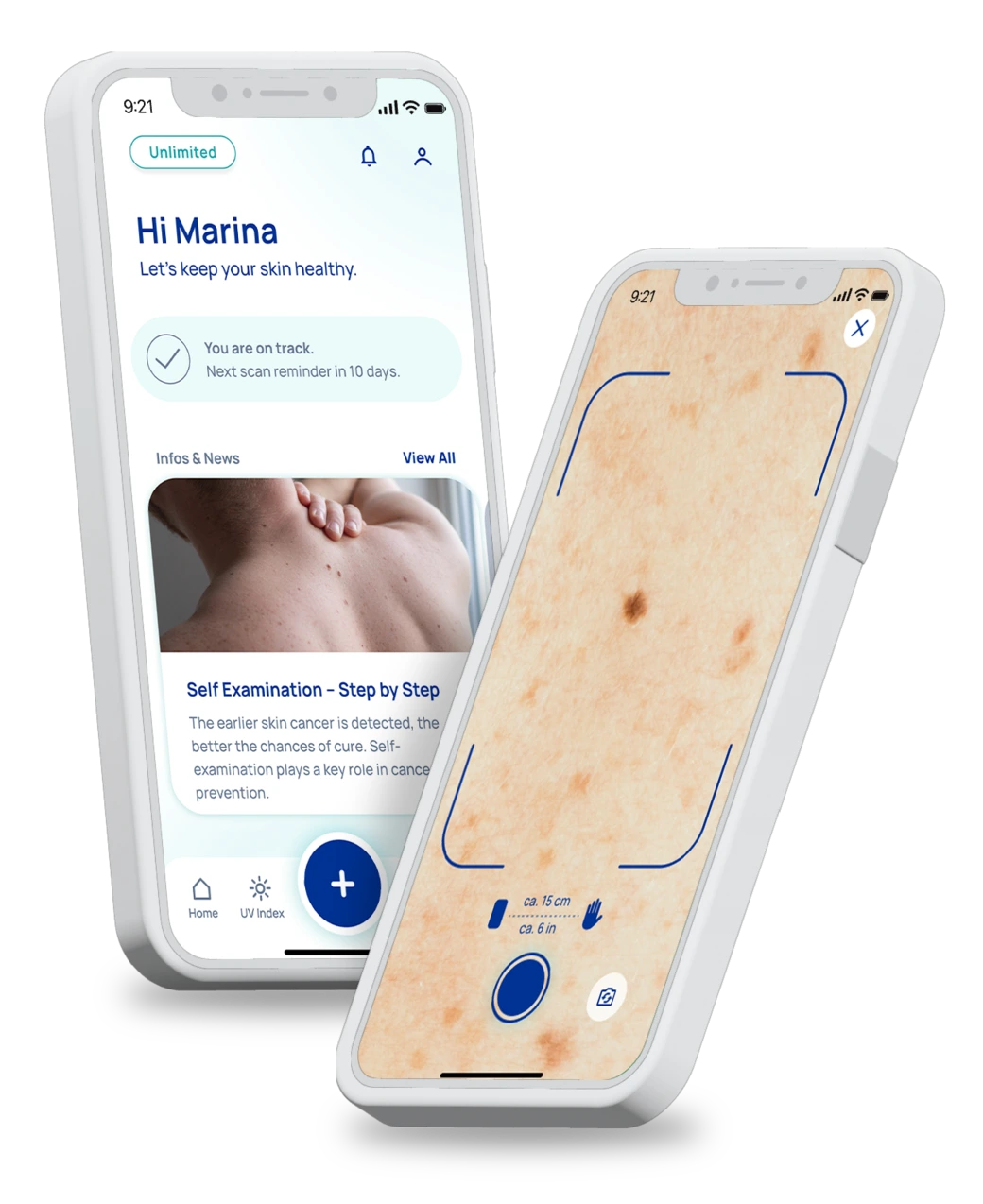
The functionality of all currently approved apps for skin cancer screening follows a similar principle. This can be illustrated using the ISO-certified and Class IIb medical device app SkinScreener (medaia GmbH, Graz): users take photos of skin changes with their smartphone camera, and the AI analyzes them based on known patterns and structures. This knowledge is built upon several thousand comparison images.
The user then receives a risk assessment from the app, typically structured in three levels (low, medium, or high risk). SkinScreener displays the risk with an easy-to-understand three-color code (green = low; yellow = medium; red = high) (see fig.).
In a recent study¹ that examined the diagnostic accuracy of this app using 1,171 benign and malignant skin tumors, both sensitivity and specificity were shown to be well above 90%.
This is a valid question, but for now, it can certainly be answered with “no.” The purpose of currently approved applications is rather to raise awareness of specific diseases (such as skin cancer) among the general population. The goal is to encourage users to engage more actively in preventive measures, so that skin cancer can be detected at early, usually still curable stages.
In addition to reducing morbidity and mortality, this could also lead to a significant reduction in healthcare costs, as expensive and often complex treatments would be needed less frequently.
It is to be expected that the use of AI in dermatology will continue to increase, so one should not ignore technological progress. However, its implementation into everyday clinical practice is still in its early stages. An important aspect is that a patient’s individual risk profile (skin type, age, gender, lesion location) is rarely taken into account in AI applications to generate more meaningful real-world data. Conceptually, this is already feasible within TBP by analyzing the skin phenotype and integrating it into lesion classification.
A previously little-considered aspect of using AI for skin cancer diagnosis is taking into account the positive and negative clinical consequences of AI-assisted decisions from both the physician’s and patient’s perspectives. In a recent study¹⁰, an AI system was trained not only to consider image-based features but also to weigh the consequences of a misdiagnosis when evaluating benign and malignant skin conditions. This led to a 12% increase in the proportion of correct diagnoses.
A critical point in applying AI-based systems is the challenge that lesions, patient groups, or diagnostic categories not represented in the training datasets may be misclassified. Studies show that in such cases, the diagnostic accuracy of algorithms drops significantly and falls well below that of dermatologists.¹¹,¹³ This underscores the necessity for AI results to always be reviewed by human intelligence and interpreted within the clinical context.